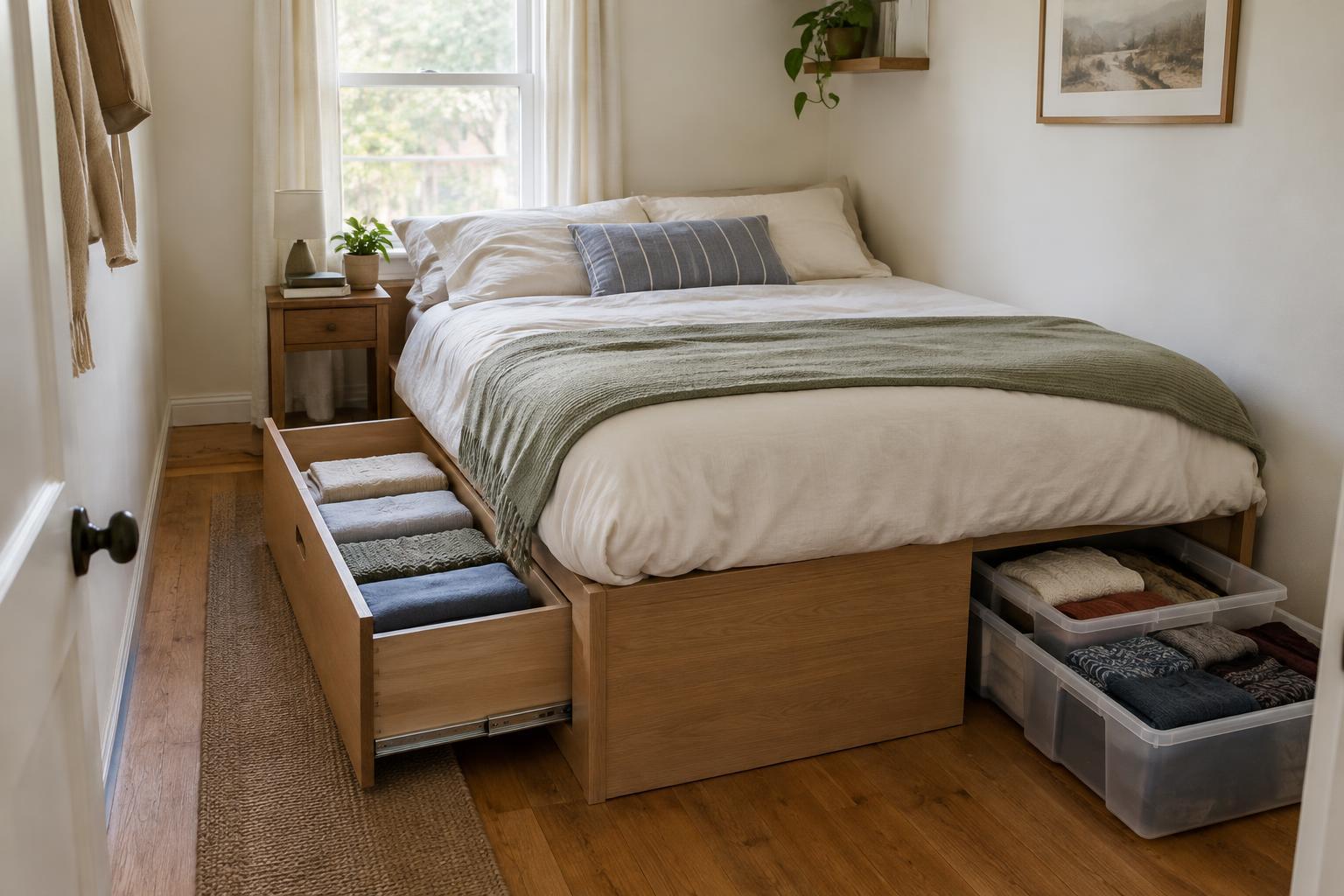
Start with the space around the bed
Both options use the space beneath your mattress, but they ask different things of the room. A storage bed may have drawers that need room to pull out, or a platform that lifts to reveal a compartment. Bins need enough clearance to slide out and somewhere to set them while you look inside. Before shopping, measure not only the area under the bed but also the walking space beside and at the foot of it.
Picture your usual routine. If one side of the bed sits close to a wall, drawers on that side may be difficult to use. A lift-up bed can avoid that problem, though you still need room to stand and operate it comfortably. Bins are easier to arrange around an awkward layout: you can pull them from the open side, use shorter ones, or leave part of the space empty.
Choose storage you will actually use
A storage bed often makes the most sense for things you reach for regularly, such as extra sheets, workout clothes or folded sweaters. Drawers give those items a defined place, so you can put them away without opening several containers. A lift-up compartment can hold bulkier belongings, but accessing something at the bottom may mean moving items stacked above it.
Under-bed bins work especially well for occasional storage: off-season clothes, spare blankets or guest bedding. Clear sides or simple labels help you find what you need without pulling out every bin. For frequently used items, choose bins that glide easily on your floor and are light enough to handle when full. A low-profile bin that technically fits is not helpful if its lid catches on the bed frame each time you retrieve it.
Whichever route you take, avoid treating the space as an overflow zone. Group similar items together and leave enough room to remove one drawer or bin without unloading everything else. In a small bedroom, storage is most valuable when it saves time as well as space.
Compare the full cost, not just the storage capacity
Bins are usually the lower-commitment choice if you already like your bed frame. You can start with one or two and add more after seeing what fits. They can also move to a closet or another room if your bedroom layout changes. Check their dimensions carefully: the usable height beneath a bed may be less than it appears because of support rails, a center leg or uneven flooring.
A storage bed is a larger furniture decision. It may replace both your current frame and another piece of storage furniture, such as a dresser, which could free valuable floor space. On the other hand, replacing a sound bed solely to gain storage may not be worth it if bins would meet the same need. Think about delivery, assembly and whether the frame will be practical to move through doorways or up stairs in a future home.
If you are deciding between models, examine how the storage opens rather than judging capacity alone. Drawer pulls, runners and lift mechanisms all affect daily use. A generous compartment that is awkward to reach may offer less practical value than a few modest bins.
Make upkeep part of the plan
Under-bed storage collects dust more easily when bins are open or loosely covered. Lidded containers can help keep stored fabrics clean, while containers with handles make it simpler to pull them out when you vacuum. Soft-sided bags may squeeze into tight spaces, but rigid bins tend to stack more neatly inside themselves when not in use and may be easier to wipe down.
A storage bed hides clutter from view, but it still needs occasional attention. Drawers can become crowded, and items in a deep lift-up compartment are easy to forget. Avoid packing either option so tightly that fabrics cannot air out, particularly if your room tends to feel damp. Store only clean, dry textiles and check the space from time to time.
The quick decision
Choose under-bed bins if your current bed works well, your budget is limited, or you want storage that can change with your needs. Choose a storage bed if you are already replacing your frame and its drawers or lift compartment would let you remove another piece of furniture. In a narrow room, pay particular attention to how the bed opens; in a shared bedroom, consider whether either person can reach the stored items without disturbing the other.
There is no need to fill every inch beneath the mattress. The better choice is the one that fits your room, holds what you actually own and remains easy to use on an ordinary day.