Start with portions, not package sizes
Before changing any measurements, check how many portions the original recipe makes and decide how many you want. A four-serving recipe needs half its ingredients for two portions or a quarter for one. If you would welcome lunch tomorrow, making two portions may be easier than trying to cook exactly one—especially when the recipe uses an egg, a can of beans, or a small bunch of herbs.
Write the new amounts down before you start. Dividing as you cook makes it easy to halve the rice but forget to halve the water. For a four-serving recipe calling for 1 cup of dry rice, use 1/2 cup for two portions or 1/4 cup for one, along with the matching fraction of the recipe’s cooking liquid. If you switch to a different type of rice, follow its usual liquid guidance instead of assuming the original ratio still works.
Scale the main ingredients, then adjust the seasoning
Beans, pasta, vegetables, and proteins are usually straightforward to divide. Seasonings deserve a little more attention. You can halve a measured amount of dried spice, but a tiny quarter-portion may be difficult to measure accurately. Start with a modest pinch, taste near the end, and add more if needed. Salt, chili, and acidic ingredients such as lemon juice are particularly easy to adjust at the table.
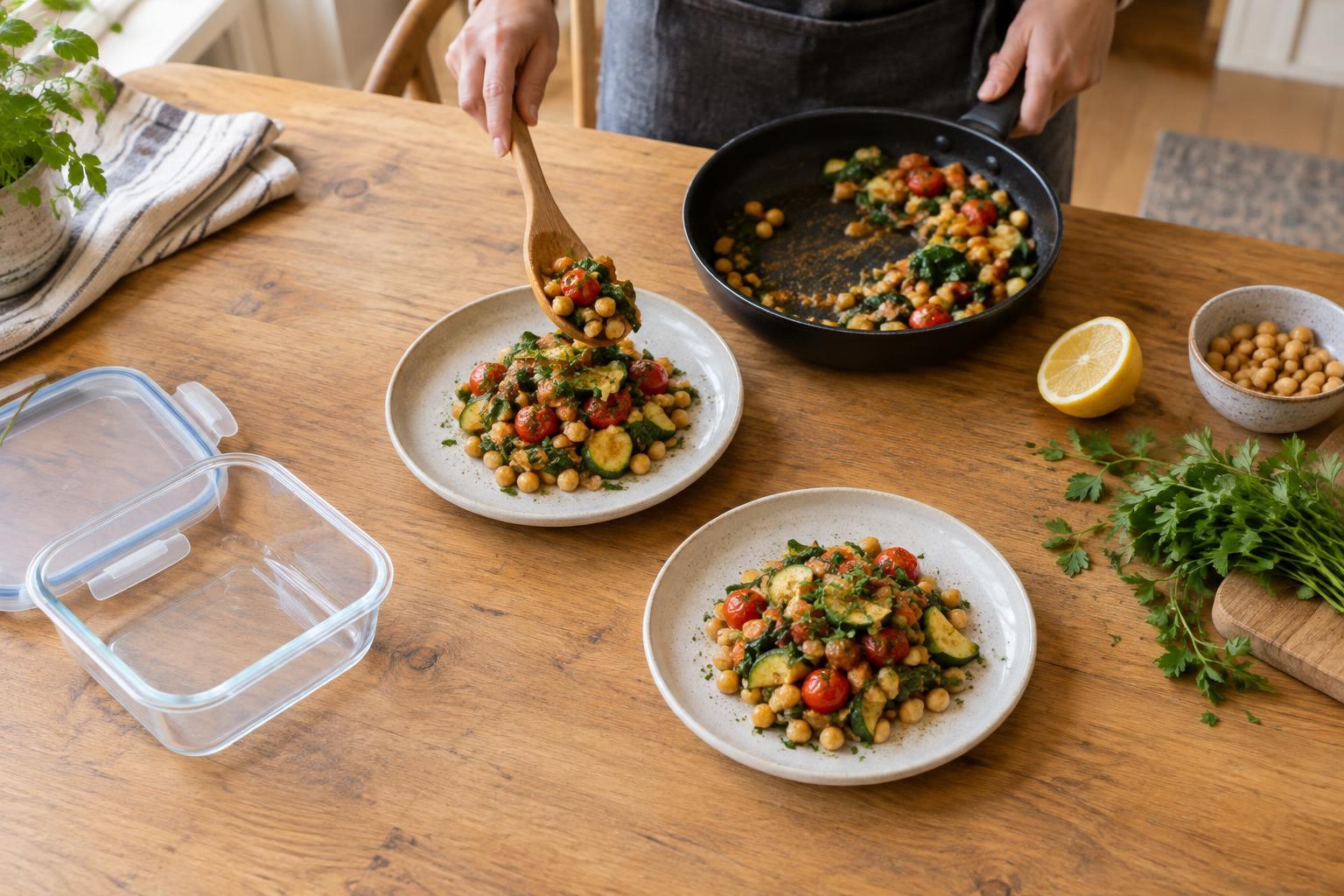
Consider a four-portion bean skillet made with two cans of beans, one can of tomatoes, one onion, and 2 teaspoons of oil. For two portions, use one can of beans, half a can of tomatoes, half an onion, and 1 teaspoon of oil. Season to taste rather than trying to divide every pinch in the original recipe. The remaining tomatoes and onion can go into a soup or pasta sauce; label and refrigerate or freeze them as appropriate.
Baking is less forgiving than a skillet meal. Flour, liquid, sugar, and leavening all affect the result, so measure them carefully. If halving a recipe leaves you needing half an egg, it may be simpler to bake the full batch and freeze portions, or find a recipe designed for a smaller yield.
Use a pan that fits the smaller batch
A reduced recipe may behave differently in the original pan. A thin layer of sauce spread across a large skillet can evaporate quickly; a few vegetables on a full-size baking tray may brown faster than a crowded batch. Choose a smaller pan when you can. If a large skillet is your only option, keep the ingredients together in one area and watch the moisture level.
For stovetop cooking, keep the heat setting as a starting point, not a rule. Stir and check earlier than the recipe suggests, adding a splash of water if a sauce thickens before the other ingredients are ready. A smaller amount does not always cook in half the time: individual pieces of potato or chicken still need time to cook through.
Oven dishes need similar judgment. A smaller casserole in a smaller dish may have roughly the same depth as the original and take a comparable time. Spread that same amount in a wide dish, and it may dry out sooner. Use the recipe’s visual cues—such as tender vegetables, bubbling sauce, or a browned top—and check before the stated finish time.
Plan for the ingredients that do not divide neatly
Scaling a recipe reduces portions, but it does not shrink the package you bought. Before shopping, look for likely leftovers: half a can of coconut milk, part of a pepper, or several spoonfuls of tomato paste. Give each one a second job. Coconut milk could enrich oatmeal or a curry later in the week; a pepper could go into an omelet; tomato paste can be frozen in small portions.
Buying the smallest package is not always the least wasteful choice. A larger bag of frozen peas, for example, lets you take only what you need and return the rest to the freezer. Pantry staples such as rice, pasta, and dried lentils are useful for the same reason: you can measure out a small portion without having to use an opened can immediately. Store leftovers promptly and follow package guidance for storage.
Keep a small-batch routine you can repeat
The easiest recipes to scale are often flexible ones: a grain bowl, vegetable soup, quesadilla, or skillet meal. Pick one main ingredient, one or two vegetables, and a flavoring you already have. You can make a single serving without turning every ingredient into a complicated fraction.
After cooking, note what actually worked. If half a recipe filled your two bowls generously, you may not need to change it next time. If the sauce disappeared in your pan, record a smaller pan choice or a little extra liquid. Those brief notes turn a family-size recipe into a reliable meal for your own kitchen.