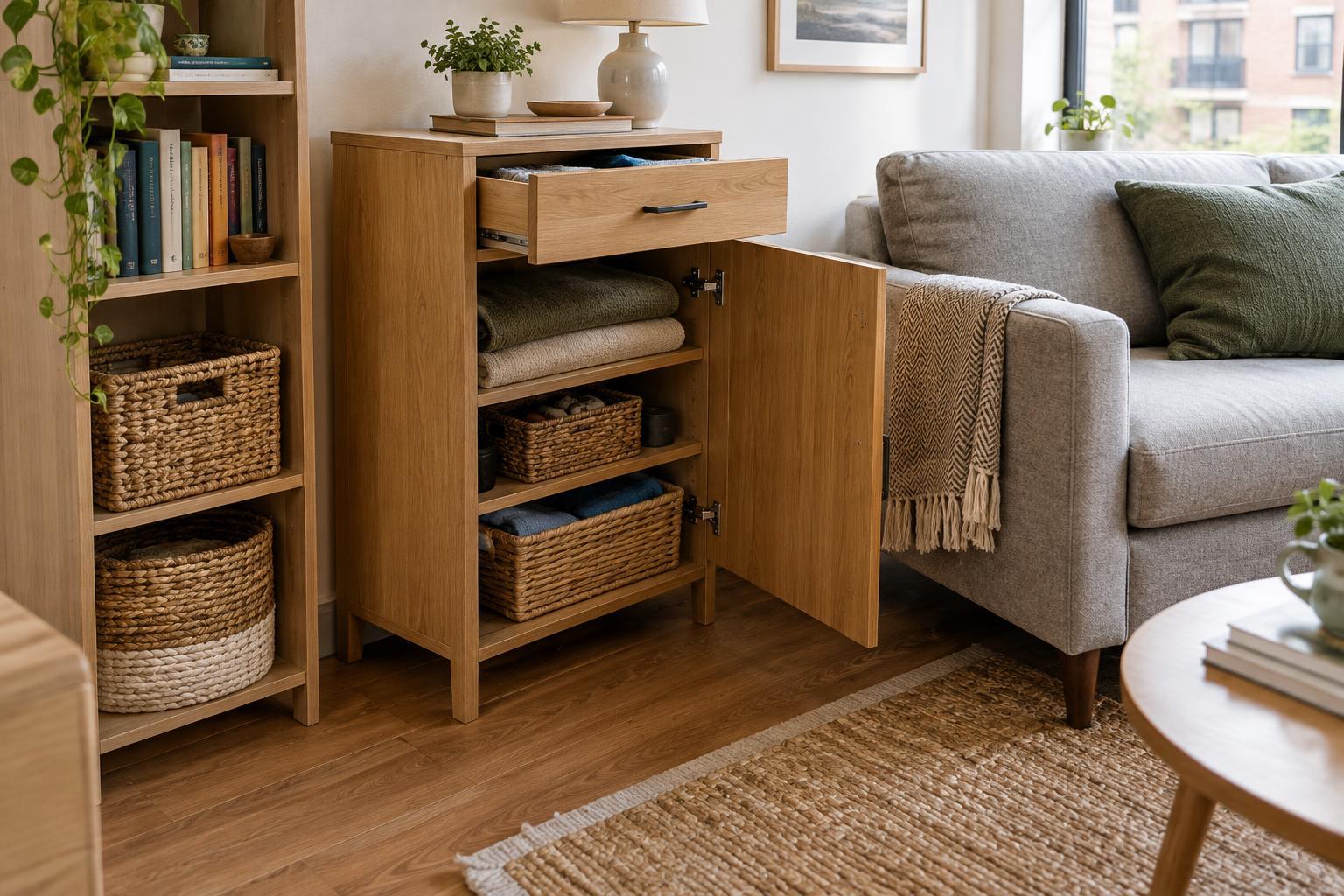
Start with the things you need to store
Before comparing cabinets, benches or drawer units, make a short list of what needs a home. Group items by how often you use them: daily essentials, occasional supplies and things you rarely need. Then note any awkward shapes. A tall vase, a stack of folded towels and a collection of small cables may occupy similar amounts of space but need very different storage.
This list gives you a better test than asking whether a piece looks spacious. Daily items should be easy to see and reach; rarely used items can go on a high shelf or at the back of a deep compartment. If an item has to be lifted out carefully, leave room around it rather than planning to fill every inch. The aim is usable storage, not a perfectly packed box.
Measure usable capacity, not just outside dimensions
Product dimensions usually describe the outside of a piece. Thick sides, a raised base, drawer mechanisms and fixed shelves all reduce the space available inside. When possible, check the interior width, depth and height of each compartment. For drawers, look at the height of the drawer sides as well as the space above them: a drawer may have room for a tall object but still make that object unstable when opened.
Compare compartments with the items on your list. Adjustable shelves may accommodate boots or cleaning bottles better than several short fixed shelves. Drawers can keep small objects separated, while one large cavity may suit blankets. A storage bench offers seating as well as space inside, but its capacity depends on the internal box and any supports beneath the lid. If interior measurements are unavailable, treat the advertised dimensions as an upper limit, not a promise of capacity.
Count the floor space and the room needed to use it
A piece’s footprint is its width multiplied by its depth. For example, a cabinet that is 30 inches wide and 16 inches deep occupies 480 square inches, or about 3.3 square feet, before you account for access. Measuring that rectangle on the floor with painter’s tape can reveal whether the piece blocks a walkway, crowds a chair or makes a door difficult to open.
Next, test the space the furniture needs in use. A hinged door must swing clear; a drawer needs room to pull out while you stand in front of it. A lift-top bench needs space above it and may require you to move cushions or other items first. Check baseboards, outlets and uneven walls, too. A narrow, tall unit can save floor space, but it may need appropriate anchoring and may not be the easiest choice for heavy items you use every day.
Give accessibility its own score
Two pieces with similar capacity and footprints can feel very different to live with. Picture the full sequence of getting one item: approach the furniture, open it, move anything in the way, take the item out and close it again. A deep cabinet might hold more than a shallow drawer unit, yet the drawer unit could be more useful for socks, stationery or kitchen tools because you can see its contents at a glance.
A simple rating can make trade-offs clearer. Mark each option easy, moderate or difficult for daily access, then repeat for occasional access. Include visibility, reach and whether other belongings must be moved. Open shelves score well for visibility but require you to manage visual clutter. Closed doors hide mismatched supplies, while labeled bins can make a deep shelf easier to navigate. Choose the kind of access that fits the items, rather than expecting one piece to work equally well for everything.
Make a small comparison before you buy
For each candidate, write down its price, outer dimensions, useful interior dimensions, opening style and intended contents. Add the taped-out footprint and any access space it needs. If you are comparing a shallow drawer unit with a deeper cabinet, do not judge them by total volume alone. Ask which one holds more of your actual items without forcing you to unpack a pile each time you need something.
Finally, consider the room around the furniture. A piece that doubles as an entryway seat or bedside surface may replace another item and earn its floor space. A bargain that obstructs a walkway may cost you convenience every day. The strongest choice is usually the one that fits the objects, the room and the way you reach for those objects—not necessarily the one with the largest stated capacity.