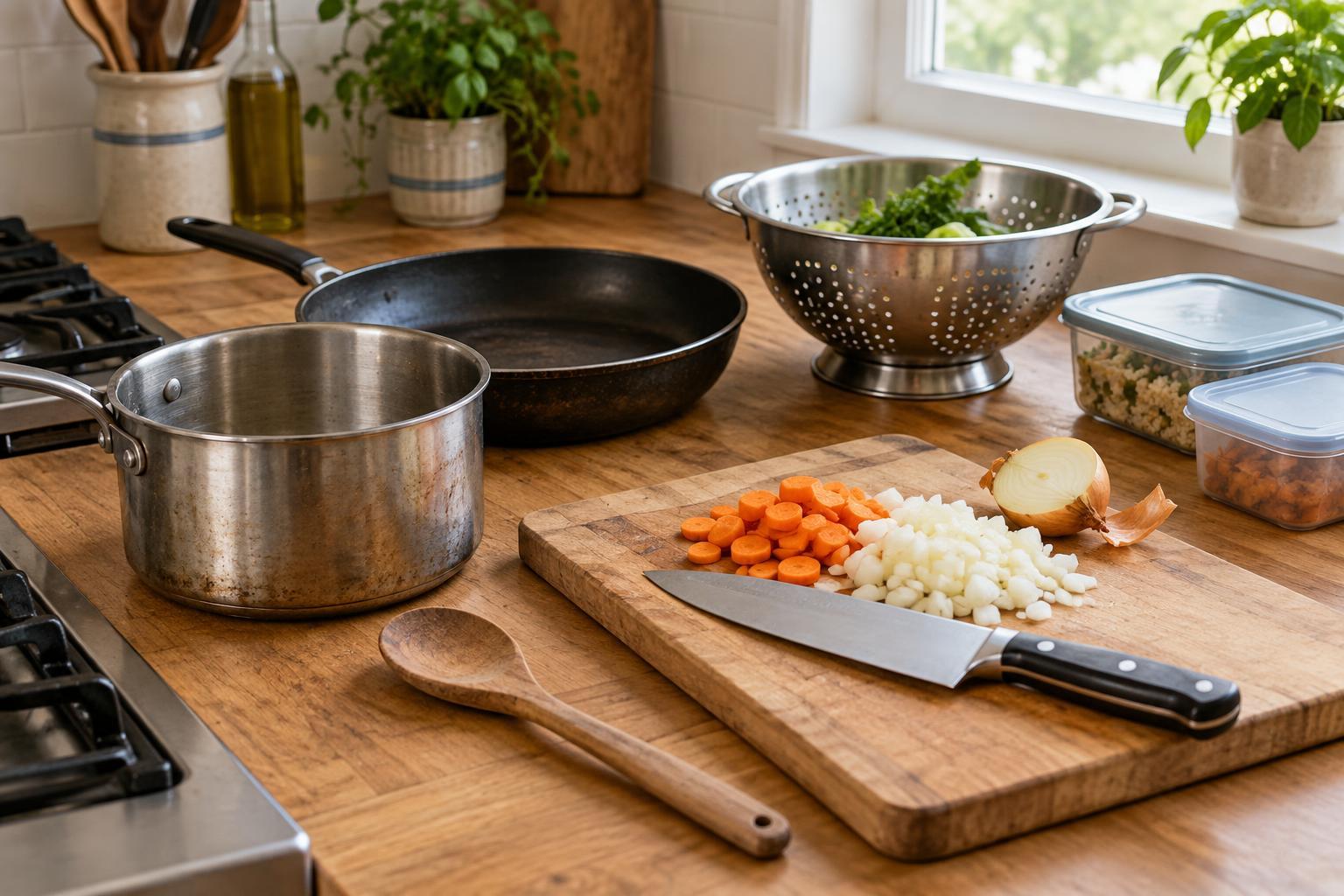
Buy for the meals you actually make
The best budget kitchen is not the one with the fewest tools. It is the one where nearly everything gets used. Before shopping, list five meals you would happily cook more than once: perhaps eggs and toast, a pot of soup, pasta with vegetables, rice bowls and a tray of roasted potatoes. Those meals reveal what you need more clearly than a boxed utensil set does.
Start with a small core and give it a few weeks. If you keep working around the same missing tool, put that item on your list. This approach leaves room in the budget for ingredients and helps prevent a crowded cupboard, especially in a small home. Check what you already own, too: a sturdy mug can stand in for a measuring cup when exact quantities are not important, and a large plate can hold chopped vegetables while you prep.
Choose a pan and a pot that earn their space
For stovetop cooking, a medium or large skillet handles eggs, vegetables, pancakes and quick sauces. A heavy pan can help food cook more evenly, but it need not be expensive. Choose a size that fits your burner, feels comfortable to lift and has a handle that feels secure. Nonstick can be convenient for delicate foods, though its surface needs gentle utensils and care; stainless steel is another versatile option if you are willing to practice heat control.
A medium saucepan with a lid covers oatmeal, rice, pasta for one or two, beans and reheated leftovers. If you regularly cook bigger batches of soup or pasta, a larger pot may be more useful than a small saucepan. A lid matters: it helps water come to a boil and lets you simmer food without excessive evaporation. You do not need an entire matching cookware set to cover these jobs.
If you have an oven, add a rimmed baking sheet when your budget allows. It can roast vegetables, cook a simple sheet-pan dinner and warm bread. Measure your oven before buying, particularly if it is compact. A rim keeps oil and juices from running off the edge, and a sheet that fits easily is more useful than an impressive one you cannot store.
Make prep safer and less frustrating
One comfortable chef’s knife or medium all-purpose knife is more useful than a block of rarely used blades. You should be able to grip it securely and control it while chopping an onion or slicing a carrot. Pair it with a stable cutting board large enough to keep ingredients from spilling over the sides. If the board slides, place a damp, clean cloth underneath it. Wash and dry the knife and board according to their materials, and keep the blade sharp enough to cut without forcing it.
A mixing bowl, a colander and a sturdy spoon cover many other everyday tasks. Use the bowl for tossing salad, mixing batter or holding chopped ingredients. Use the colander for draining pasta and rinsing produce. A wooden spoon or heat-safe silicone spatula can stir, scrape and serve; choose one that suits your pan’s surface. If you often open cans, a reliable can opener belongs on the essentials list as well.
Measuring tools depend on how you cook. Measuring spoons are inexpensive and helpful for baking or seasoning from recipes. Measuring cups are worth adding if you frequently follow recipes where proportions matter. For flexible dishes such as soup or stir-fry, you can often learn to judge amounts by eye. Buy precision where it improves the food you actually make.
Let leftovers and cleanup shape your choices
Cooking extra portions only saves effort if you can store them conveniently. A few stackable, food-safe containers with lids that fit securely are usually enough to begin. Clear containers make leftovers easier to spot, while similar sizes stack more neatly than a collection of mismatched tubs. Choose sizes you will use: one for a lunch portion, another for a larger batch. Follow the container maker’s guidance before using it in a microwave or freezer.
Keep cleanup simple with a dish brush or sponge, dish soap and a towel or drying space. A pan that is awkward to wash may get used less, even if it was a bargain. The same applies to tools with tiny parts or hard-to-reach seams. When comparing two options, consider how they fit in your sink and cupboard as well as how they cook.
Shop slowly and spend where it counts
Secondhand shops, community exchanges and individual open-stock pieces can be good ways to build a kitchen without paying for a full set. Inspect used items carefully: pans should sit flat, handles should feel firm, and food-contact surfaces should be easy to clean. Skip damaged nonstick coatings and anything whose condition you cannot assess. For knives, comfort and control matter more than a long list of features.
A sensible buying order is a knife and board, one pan or pot suited to your usual meals, a stirring utensil, and the basic tool needed to drain, open or measure your most-used ingredients. After that, let repeated cooking answer the question. If you bake every weekend, a baking dish may earn its shelf space. If you never blend soups, a blender can wait. The goal is not to own every kitchen tool; it is to have a small set that helps you make dinner without a detour to the store.