Set up a steady workspace
You do not need a large kitchen or a drawer full of knives to prepare vegetables well. Start with a cutting board that gives you room to move the knife without crowding the counter. If the board slides, place a damp kitchen towel underneath it. Clear away spare bowls, packaging and anything that might catch your elbow. A bowl for chopped ingredients and another for scraps can keep even a small workspace manageable.
Choose a knife that feels comfortable in your hand and is suited to the ingredient. A medium-size chef’s knife works for many everyday tasks; a smaller knife may feel easier to control for fine work. A reasonably sharp blade generally needs less force than a dull one, but it still deserves your full attention. Cut slowly enough that you can see where your fingertips are going. If someone interrupts you, set the knife down before turning away.
Use your hands to guide the cut
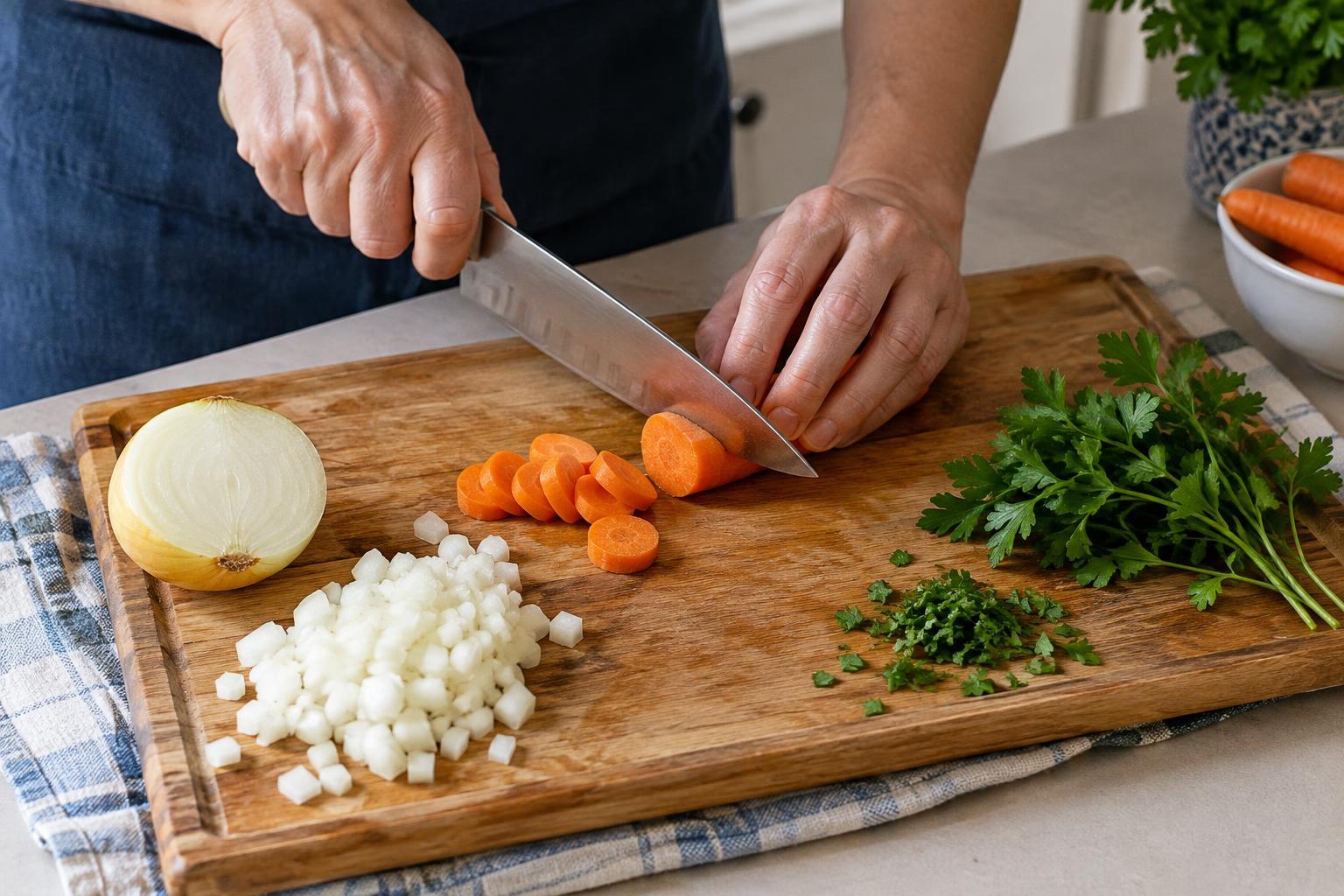
Hold the handle securely, with your hand close enough to the blade to control its direction. If it feels natural, gently pinch the blade just in front of the handle between your thumb and forefinger, then wrap your other fingers around the handle. You do not need to squeeze hard. Your other hand guides the food: curl its fingertips inward so your knuckles, rather than your fingertips, face the side of the blade.
Keep the knife tip and cutting edge pointed down toward the board as you work. Move the guiding hand back a little after each cut instead of chasing speed or perfectly even pieces. A flat side on the ingredient helps prevent rolling. When a piece becomes too small to hold comfortably, stop and reposition it rather than trying to make one last thin slice. Use the flat of the blade or a bench scraper to move chopped food; avoid dragging a sharp edge across the board with your hand.
Chop an onion without losing control
Trim the stem end of the onion, cut the onion in half from stem to root, and peel away the papery skin. Set each half cut-side down so it sits firmly on the board. Leave the root end attached while you make several lengthwise cuts toward it, stopping before the root. This holds much of the onion together while you work. Turn the half as needed so you can keep your wrist comfortable and your guiding fingers away from the blade.
Next, cut across those lengthwise slices to make chopped pieces. Wider spacing gives you larger pieces for a stew or tray bake; closer spacing gives you smaller pieces for a sauce. There is usually no need to add a horizontal cut through the middle, especially while you are learning. Once you reach the root, set that small piece aside instead of trying to dice every bit. The goal is a useful pile of onion, not a perfect one.
Make carrots stable before slicing
Wash the carrots, trim the ends and peel them if you prefer. For simple round slices, hold a carrot firmly and cut crosswise, taking extra care if it is thick or uneven. If it wants to roll, cut it into shorter lengths and slice a thin strip from one side of each length. Place that newly flat side on the board before continuing.
For smaller pieces, halve a short length of carrot lengthwise, lay each half flat, then cut it into strips. Turn the strips and cut across them to make roughly diced carrots. Keep the pile small enough that you can guide it securely; loose stacks can shift under the knife. Pieces of similar size tend to cook more evenly, but they do not have to match exactly. If you are making soup, a few slightly different shapes will usually be fine.
Handle herbs gently and finish safely
Rinse herbs if needed and dry them well, since wet leaves can cling to your hands and knife. Remove any tough stems, then gather a small handful of leaves into a loose mound. For larger leaves, you can stack a few, roll them gently and slice across the roll into ribbons. For a finer chop, pass the knife through the mound a few times, regrouping it between passes. Repeatedly hacking at herbs can bruise them and turn a neat pile into a damp one.
When you are done, put the knife down before clearing the board. Wash it separately rather than leaving it hidden in a sink full of dishes, and dry it carefully by wiping from the spine toward the edge. Store it where the blade is covered or protected. With each meal, focus on a stable ingredient, tucked fingertips and an unhurried pace. Those habits matter more than how quickly you can fill a bowl.